Techniques for World-Building in Fiction: Constructing Worlds That Serve the Story
Published
Readers rarely remember a story for its maps or timelines. They remember how it felt to be there: the smell of a market, the tension of an unspoken rule, the sense that the world existed before the first page and will go on after the last. That feeling is the product of world-building, and the best of it is nearly invisible. This guide covers how to build a world with setting, culture, and history, and how to make it enhance your story instead of burying it.
What World-Building Actually Is
Wikipedia defines worldbuilding as the process of constructing an imaginary world or setting, most often in speculative fiction like fantasy and science fiction. A well-built world has coherent history, geography, culture, and ecology, and it can range from many planets to a single village [1].
The idea has a literary pedigree. Per the same source, J. R. R. Tolkien called a constructed world a "secondary world" or "sub-creation," and argued that such a world can focus on the world itself rather than just the plot. He made his feel real by framing it with narrators and story versions, much like an actual mythology [1].
That last detail is a clue to everything that follows: a world feels real when it feels lived in, with layers and a past, not when it is merely described.
Choose Your Starting Point: Top-Down or Bottom-Up
Wikipedia outlines two broad approaches [1]:
- Top-down: Start with broad features such as inhabitants, technology, geography, climate, and history, then add finer detail, from continents down to towns. The result is well integrated, but it takes a lot of work before you have anything usable.
- Bottom-up: Start with a small area and detail its geography, culture, politics, and people, sketching the surrounding regions more loosely as you go. This is quick to use for a specific story, but it can produce inconsistencies.
The source adds that the two can be combined, at roughly twice the effort, and notes a third option, inferred worldbuilding, in which the creator supplies enough detail that audiences can reasonably fill in the gaps [1]. For most fiction writers, bottom-up with a few top-down anchors is a practical compromise: know your big rules, then build in detail only where your characters walk.
Setting: The Physical World
Setting is more than scenery. Wikipedia notes that terrain shapes climate, biomes, trade routes, city locations, and conflicts over resources [1]. A river is not just pretty; it is a highway, a border, and a reason for a city to exist.
Skillshare's guide suggests deciding whether your world is Earth or another planet, then defining its buildings, bodies of water, vegetation, sky, air quality, weather, and animals [6]. When it is time to put setting on the page, one writing resource recommends engaging the senses, such as footsteps on stone, food odors in a market, or wind through narrow streets, instead of cataloguing architecture [3].
Culture and Politics: How People Live
A place becomes a world when people live in it. Famous Writing Routines argues that culture, politics, and history should shape characters and plot rather than sit in separate blocks of exposition [2]. Its advice breaks down like this:
- Culture: Language, idioms, and slang help define a society's identity. Rituals can drive the plot or deepen a character, and a character's reaction to a ritual can reveal personality or background. Shared values and norms create friction when characters come from different backgrounds.
- Politics: The system of government should affect daily life, and power relationships based on class, race, or religion can generate conflict. Someone from a marginalized group in an oppressive society faces different challenges than someone from a privileged one [2].
Skillshare's checklist for this layer is useful: how do people live, what government do they have, is conflict or crime common, how do cultures and languages differ, what work do people do, and what religions do they follow [6]?
History: Why Things Are the Way They Are
History is what gives a world depth. Skillshare advises giving the world a plausible, consistent past, since events shape everything in it, and, for historical fiction, researching the period closely so details like clothing, food, and buildings are accurate [6].
The best history is connected to the present. Famous Writing Routines says past events, such as wars that redrew borders or revolutions that toppled regimes, should logically connect to the current world, and that myths and legends can shape a culture's beliefs. Characters can be driven by historical wrongs they want to right, a prophecy they must fulfill, or traditions they feel bound to uphold [2]. Wikipedia makes the same point: past events explain current relationships between groups and can drive the plot [1].
Magic and Rules: Keep Them Consistent
If your world bends physics, the rules need to hold. Wikipedia notes that worlds may follow real physics, alter it, or blend in magic [1], and Skillshare names consistency across history, physical description, and characters as the main guideline for keeping a world believable [6].
Fantasy author Brandon Sanderson's third law of magic gives a useful discipline: expand what you already have before you add something new. The principle favors depth over breadth. Rather than piling on new powers, cultures, and characters, take a few existing elements, explore their consequences across society, and tie them to the story's themes. One example from the post: a single distinctive magic can be used differently by each culture, rather than inventing a unique system for each one. The author also cautions that this is a balancing act that depends on the story [4].
The Biggest Trap: The Info Dump
Many writers who build rich worlds then make the same mistake: they explain all of it. Author Helen Lowe, drawing on Ursula Le Guin's Steering the Craft, calls this the "expository lump," a lecture disguised by a thin narrative device. Le Guin's remedy is to break information into small pieces and weave them into the story, so readers absorb it without noticing [5].
Lowe adds that secondary-world fantasy is especially vulnerable because readers cannot assume our world's rules apply, and writers who have researched heavily are tempted to share everything they have learned. Her two rules of thumb are to keep it simple and to include only what the story needs. She cites the appendices to The Lord of the Rings as fascinating material that the trilogy itself does not require. For her novel Thornspell, she read several nonfiction histories to include only a handful of sentences about the era, concluding that most of the work should stay hidden beneath the surface [5].
Famous Writing Routines offers practical techniques for staying out of the lump [3]:
- Show through action. Demonstrate how magic works by having a character use it under pressure.
- Release details gradually, only when the story needs them.
- Use conversation, such as a character explaining a custom to a newcomer, as long as it sounds natural.
- Tie the world to the plot. A journey can showcase a city's landscape and history.
- Vary the viewpoint. A noble and a peasant notice the same society differently.
- Trust readers' imaginations. A few well-chosen details can suggest a larger world.
The same source suggests revealing background through dialogue, in-world texts, or scars on the landscape [2].
A Quick World-Building Checklist
These questions, drawn from the sources above, can guide a draft:
- Does the setting shape the plot? Terrain, climate, and resources should create opportunities and problems.
- Do culture and politics touch my characters' daily lives?
- Is the history connected to the present? Past events should explain current tensions.
- Are the rules consistent? Especially if there is magic or invented technology.
- Am I expanding before adding? Depth often beats novelty.
- Does this detail earn its place? If the story works without it, leave it out.
The Takeaway
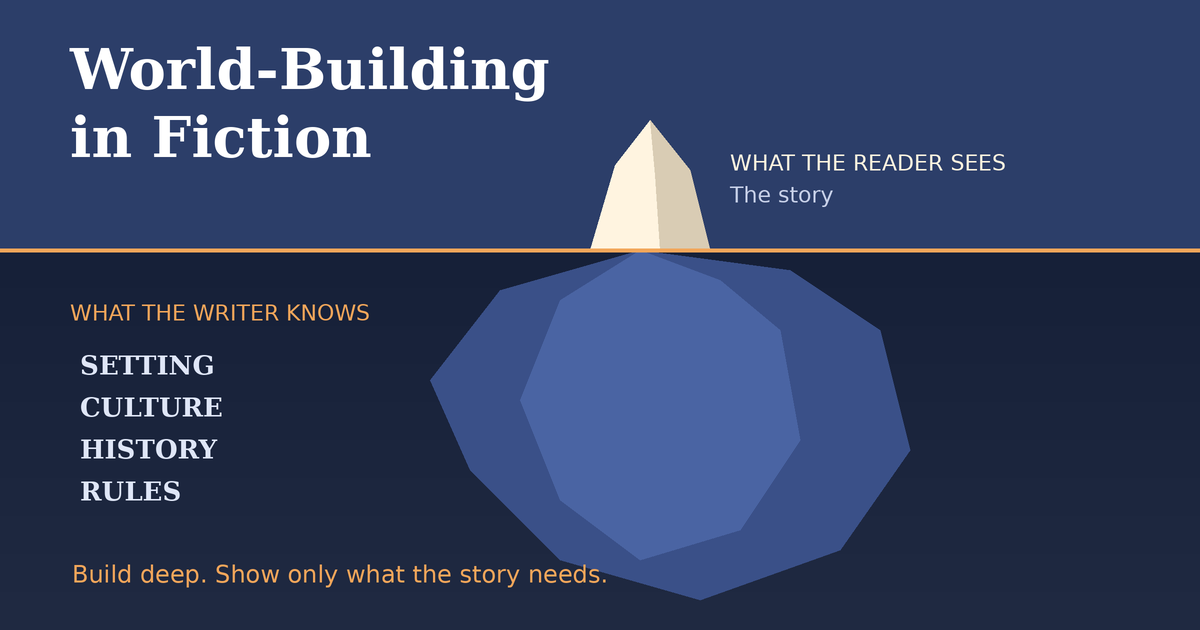
World-building is an iceberg: most of it belongs under the water. Build enough to know your world's geography, customs, and past, and then let the story reveal only what it needs, through action, conflict, and the senses. Do that, and readers will feel the weight of a world they never saw in full.
Sources
- Wikipedia, "Worldbuilding." https://en.wikipedia.org/wiki/Worldbuilding
- Famous Writing Routines, "The Art of World Building: How to Weave Culture, Politics, and History into Your
- Famous Writing Routines, "How to Avoid Info Dumps While World Building."
- Brandon Sanderson, "Sanderson's Third Law of Magic."
- Helen Lowe, "On Worldbuilding: Beware the 'Expository Lump!'"
- Skillshare, "Guide to World Building." https://www.skillshare.com/en/blog/guide-to-world-building/
Narrative." https://famouswritingroutines.com/writing-tips/the-art-of-world-building-how-to-weave-culture-politic s-and-history-into-your-narrative/ https://famouswritingroutines.com/writing-tips/how-to-avoid-info-dumps-while-world-building/ https://brandonsanderson.com/sandersons-third-law-of-magic/ https://helenlowe.info/blog/2022/02/14/on-worldbuilding-beware-the-expository-lump/ The iceberg comparison, the river example, and the checklist wording are the author's own synthesis of the ideas in the sources above.