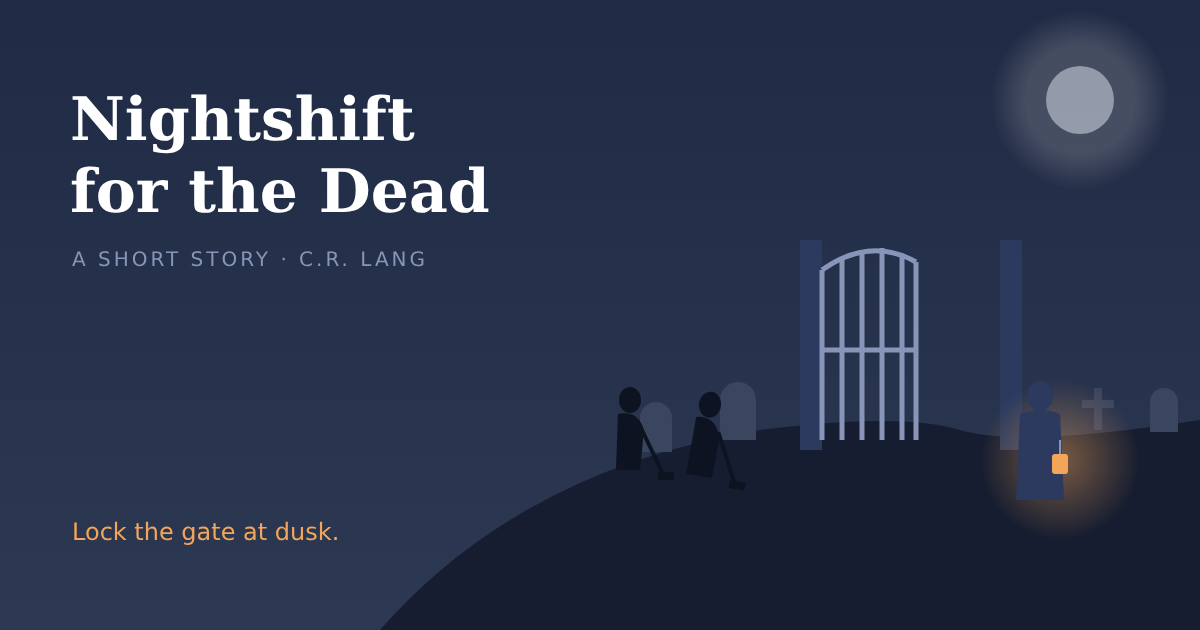
Nightshift for the Dead
Horror · Published
Harlan Teague had kept the Greywater Cemetery for twenty-two years, and in that time he had learned two rules. Lock the gate at dusk, and never be on the grounds after midnight. The first was in his contract. The second was something he had arrived at on his own, without ever quite deciding to.
He was a man who valued routine, so he did not question it. The town of Greywater Falls did not question much of anything. The streets were always smooth. The clocks on the courthouse and the bank and the old Methodist steeple all kept the same flawless time. Potholes did not last the winter. Streetlights did not stay dark. Visitors remarked on it and put it down to civic pride.
Harlan might have gone on believing that, if not for the night his truck broke down.
It was a Tuesday in November, a little past one in the morning. He had stayed late to finish the paperwork for a burial scheduled at dawn, and when he turned the key, the engine gave only a dry click. He sat in the cab, listening to the dark settle against the windshield, and then he noticed the sound.
It was a soft, steady rasp, rhythmic and patient. It was the sound of a shovel biting into gravel.
He got out. The cold was the thin, clean kind that goes straight through a coat. Down the hill, beyond the rows of stones, the cemetery road ran toward the town gate, and along it, in the pale wash of a moon he could barely see, figures were bent to their work.
There were dozens. They moved slowly, without hurry, and they did not speak. Some wore the remains of suits, some the remains of dresses, and some wore nothing that had held together long enough to be called clothing. They were filling a pothole with gravel, tamping it flat with the backs of their spades, working in a line with the unthinking precision of men who had done the same job a thousand times.
Harlan stood very still behind the gatepost, and he understood three things in quick succession.
The first was that he knew some of them. The woman with the grey braid was Edith Marsh, whom he had buried in the spring. The tall man pulling cable from a utility box was old Mr. Dunmore, who had been in the ground since the year Harlan started.
The second was that none of them looked at him. They knew he was there. He could tell by the way the nearest ones angled their shoulders away, giving him a wide, courteous berth, as a worker steps around a supervisor who is not meant to be disturbed.
The third was that he was not afraid. That frightened him more than anything.
After that night, he began to watch.
He did it carefully. He sat in his kitchen with the lights off and the window cracked and listened to the town work itself. Close to midnight, the sounds began: a distant clatter of tools, the rasp of wire, the low tick of gears being coaxed back into time. By dawn, the courthouse clock had been wound, the bank clock had been corrected by eleven seconds, and a crack in the church steps had been filled so cleanly that the mortar looked like it had grown there.
The dead mended Greywater Falls. They painted fences and cleared drains. They righted tipped bins and swept the leaves from the gutters of widows who had forgotten how to climb a ladder. In the morning, the living woke to a town that had been quietly made right, and none of them wondered how.
Harlan told himself it was a kind of gift. He tried to believe it for almost a month.
Then he noticed that people were going missing.
It was never dramatic. A man named Voss, who had moved in the previous spring and played music in his garage until three in the morning, one day was simply not there. His house stood open. His guitar leaned against the wall. The neighbors said he must have left town, and by the following week no one remembered his face.
A woman on Alder Street, who had lodged a dozen complaints with the council about the “noises at night,” was found by the river, serene, unmarked, her hands folded as if arranged. The coroner called it exposure.
A boy who had been seen with a flashlight, wandering the streets after dark, taking photographs, did not come home. His camera was found on the cemetery road, the lens carefully wiped clean.
Harlan understood the pattern the way he understood weather. The dead worked at night, and the town kept their hours. And anyone who interrupted that work, who stayed out too late, who looked too hard, who made noise or asked questions, was dealt with in the same patient, unhurried manner as a pothole or a cracked step. They were smoothed over. They were made to fit.
It was maintenance. That was the word that kept coming to him. A town like this did not run on its own. It needed upkeep, and upkeep required that nothing disturb the routine.
On the first of December, the dead came to his door.
He was sitting in the dark, as he did most nights, when he heard the knock. It was soft and measured, three taps. He opened the door.
Edith Marsh stood on the step. Her braid had been neatly redone, and the soil still clung to her sleeves. She did not speak, because she did not appear to have the means. But she held out her hand, and in it was a small brass key, tarnished with age.
He recognized it. It was the key to the cemetery’s old maintenance shed, the one at the very back of the grounds that he had never opened in twenty-two years, because the lock had rusted shut and it had never seemed to matter.
He followed her through the dark. The others fell in behind him without a sound, a long quiet column, and he realized with a slow, sinking certainty that they were not leading him. They were escorting him, the way you escort someone to the place where their name is already written.
The shed door opened easily. The key turned as if freshly oiled. Inside, on a plain wooden table, lay a ledger, and beside it a pair of work gloves, folded, and a lantern, and a spade with a handle worn smooth by decades of hands.
He opened the ledger. It was a list of names in a dozen different handwritings, going back more than a century. Each name was a caretaker. The last was Walter Pike, 1998.
Beneath it was a blank line.
He understood then why the roads were smooth and the clocks were true and the town never changed. The dead had never needed a keeper to guard them. They needed one to remember them, to keep the gate, to unlock it at the right hour and lock it behind them again, a living hand to make the arrangement lawful. Someone who knew the rules and followed them without asking why.
Someone who valued routine.
Edith Marsh pressed the pen into his palm. Her fingers were cold as river stone, and unexpectedly gentle.
Harlan Teague looked at the blank line for a long time. Outside, the night was filling with the soft sound of shovels. And he understood the last and most terrible thing, which was that he was not afraid, and he never had been, because some part of him had always known whose shift he was keeping.
He signed his name.
In the morning, the gate was unlocked at dusk, and the town of Greywater Falls slept soundly, its clocks all true, its streets all smooth, and its caretaker standing quietly among the stones with a lantern, waiting for midnight.