The Room Between Blinks
Horror · Published
Iris Calloway had photographed weddings for nine years before she photographed the room.
It happened by accident, at a reception in a rented hall outside Asheville. She was shooting at the slowest shutter speed her camera allowed, trying to catch the blur of the dancing, when the bride’s grandmother turned and blinked directly into the lens. Iris pressed the button at that exact instant. On the back of the camera, the frame showed a woman with her eyes closed, which was ordinary, and behind her, where the reception hall should have been, a different space entirely.
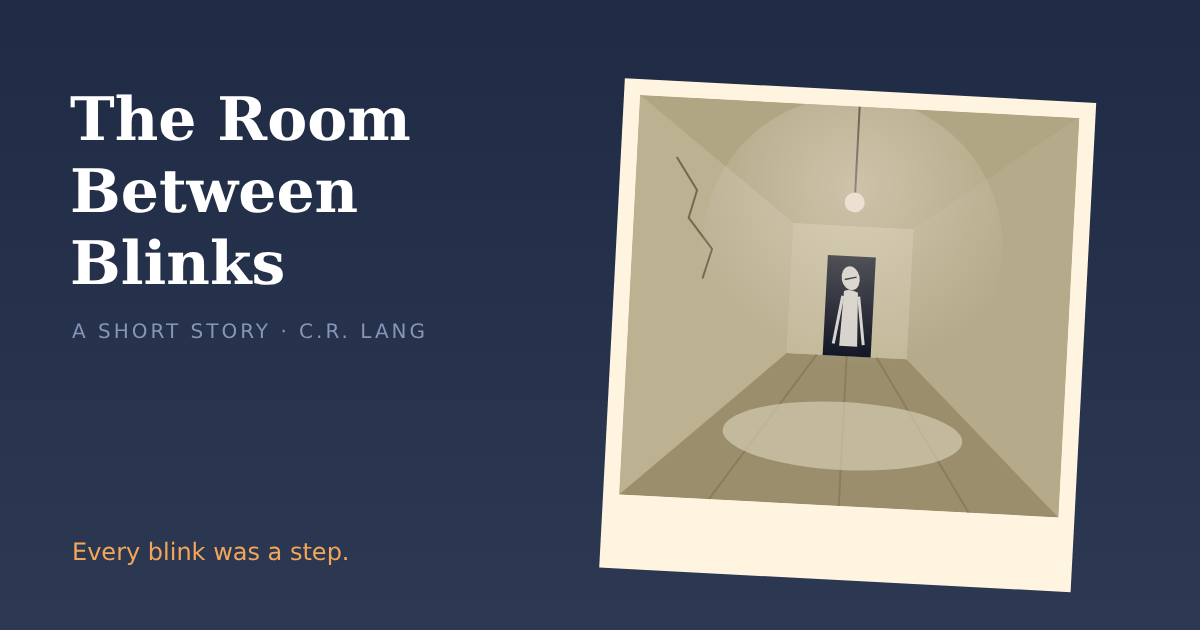
It was a long, narrow room with a low ceiling and walls the color of old teeth. There was no furniture. A single bare bulb hung from a cord, and beneath it the floorboards were worn pale in a rough circle, as though something had paced there for a very long time.
She deleted the frame, assuming it was a double exposure. Then she tried to recreate it, and found she couldn’t. She could only get it by timing the shutter to the closing of someone’s eyes.
She told herself it was a curiosity, a hobby. She began carrying a small tripod and shooting strangers on the train, in cafés, in the waiting room of her dentist’s office, each time waiting for the flicker of a lid and the soft mechanical click. A blink lasts about a third of a second. It took her four hundred attempts to learn the rhythm of it, the way you learn to catch a falling coin.
But the room was always there. Always the same room, in the gap behind every blink. The same bulb, the same pale circle on the floor, the same peeling walls. She laid the prints out across her apartment floor and saw that the room was not static. In each frame, something had shifted. The bulb hung a little lower. A crack had spread across the plaster. A dark smear on the far wall, which in the first print was barely a shadow, had grown by the fortieth into the shape of a doorway.
The room was not a place. It was a place that was being approached.
She understood then that every person who blinked in front of her was briefly standing in it. For a third of a second, the whole world went there, and came back, and never noticed.
On the sixty-first day, she photographed her own face in the bathroom mirror.
She shot it at arm’s length, timing the button against her own lid. The frame showed what she expected: her own closed eyes, and behind her, the narrow room. But she was standing in it. Her reflection stood on the pale boards beneath the bulb, hair mussed, mouth slightly open, and the camera in her hands looked wrong. It looked like an object that had no business in that place.
Then she noticed the doorway on the far wall.
It was open. It had never been open before. Beyond it was a dark that did not look like the absence of light so much as the presence of something that had been waiting patiently to be looked at.
And in the dark, very faintly, there was a pale shape, roughly the height of a person. It was standing with its head tilted, the way a person tilts their head when they have just heard their name.
She threw the camera onto the bed and did not touch it for two days.
When she went back, she told herself it was for science. She set the camera on its tripod, aimed it at a mannequin with painted eyelids, and rigged a remote shutter to a metronome. She wanted a subject that could not be harmed. She wanted a record.
The frames came out in a sequence of twelve. She lined them up on the monitor and flipped through them like a flip book.
In the first, the doorway was shut.
In the second, it was ajar.
By the fifth, the pale shape stood in the doorway.
By the eighth, it was in the middle of the room, directly beneath the bulb, and its head was turned. Not toward the mannequin. Toward the lens.
She could see it more clearly now. It was too thin, and its arms hung too long, and where its face should have been there was only a smooth, pale plane, creased in the center like a fold in paper. As she watched, in frame nine, the crease opened. It was not a mouth. It was a horizontal slit, and it opened, and closed, and opened again, in a slow, deliberate rhythm.
It was blinking.
In frame ten, it was close enough that its fingers were visible. They were gray, and jointed in too many places, and they were resting against the inside of the glass, as if the photograph were a window.
In frame eleven, the slit opened wide, and she could see that what lay behind it was not an eye. It was another room.
She turned off the monitor. She sat with her hands pressed between her knees until they stopped shaking, and when she looked up she saw her own reflection in the black screen, and her own eyelids, and she understood what she had been missing.
She had been taking pictures of the room, but the room had been taking pictures of her.
She stopped. She sold the camera, and the tripod, and the prints. She taped over every mirror in the apartment, then took the tape down because it only made her look at the tape. She told no one. Who would she tell?
For eleven days, she thought it was over.
On the twelfth, she woke at 3:00 a.m. with the strange conviction that she was being watched. She lay perfectly still, staring at the ceiling. Her eyes were dry. She had not blinked in some time, she realized, and when she tried to stop herself from blinking, she found the urge had become a pressure behind her lids, a slow swelling ache. She held out for forty seconds. Then sixty. Her eyes streamed. The ceiling swam.
The bulb, she thought. Where is the bulb?
She blinked.
For a third of a second she stood on pale floorboards beneath a bare bulb hanging low enough to touch her hair. The walls were the color of old teeth. The doorway on the far wall was wide open, and the pale shape stood in the center of the room, close enough to touch, its head tilted, its slit-mouth parted in what she knew with perfect certainty was patience.
Then she was back in her bed, in her apartment, with the streetlight leaking through the curtains and the radiator ticking in the dark.
She lay there, shaking. She had been gone for a third of a second. That was all.
But the thing had been closer than in any frame she had taken. And she understood the arithmetic of it. Every blink was a step. Every blink, a little nearer to the camera, and she had spent two months teaching it where to look.
She could not stop blinking forever. No one can.
She lay in the dark and listened to her own pulse and counted the seconds, and somewhere in the count her eyelids began to tremble, and on the far side of the dark, patient and attentive, something that had learned to keep its eyes open waited for her to close hers.