The Love Lockdown
Romance · Published
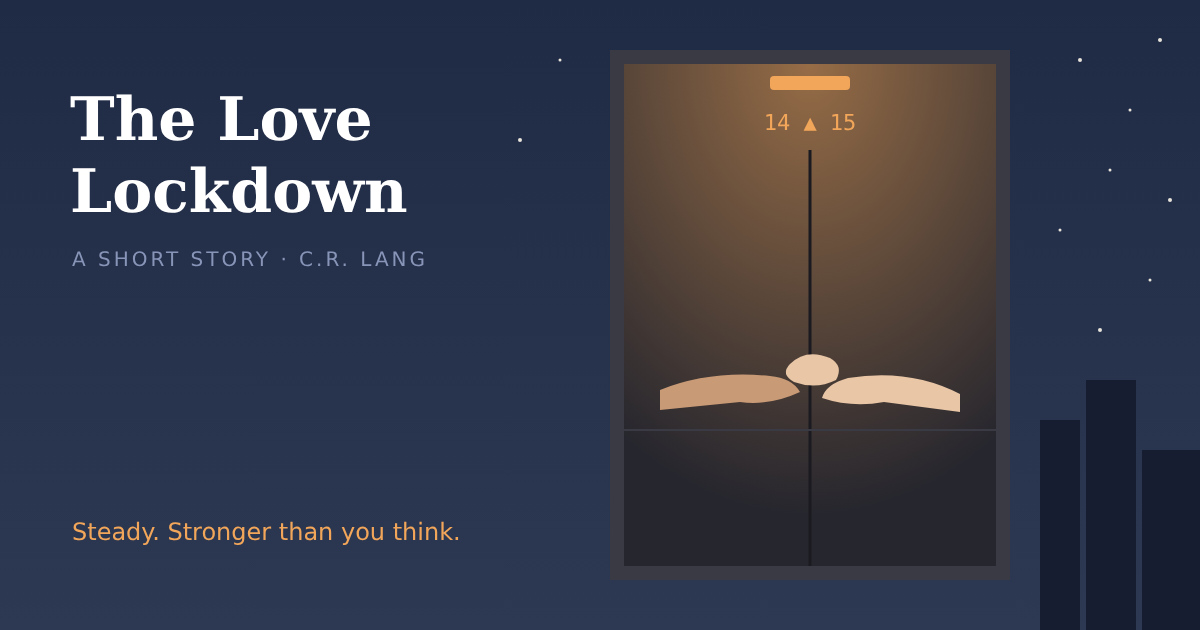
The elevator stopped between the fourteenth and fifteenth floors at 6:47 p.m., and the lights went out one second later.
For a moment, nobody said anything. There was only the dull, mechanical sigh of the car settling on its cables, and the sound of six strangers deciding not to panic.
Then the emergency lamp flickered on, a weak amber glow above the door, and Priya Nair, who had been holding a takeout bag against her chest like a shield, said, “Does anyone else’s phone have signal?”
None of them did. The screens lit their faces one by one with the same small, useless message. No service. Somewhere beneath them, muffled by steel and concrete, a siren began to rise, and then another, and then a long, tangled chorus that seemed to come from the whole city at once.
“Blackout,” said the man in the corner, a tall, gray-haired figure in a rumpled suit. “Citywide, from the sound of it.”
“Or something worse,” muttered the college kid beside him.
“Or a blackout,” said the older man firmly, in the voice of someone who had calmed a great many rooms. “Let’s start with that.”
There were six of them. Priya, a nurse coming off a double shift, her scrubs still creased from the hospital. Walter Bram, the gray-haired man, a retired judge on his way to a dinner he had been dreading. A college student named Theo, who carried a guitar case and an air of desperately concealed fear. A woman in a red coat named Celeste, who had not stopped checking her phone since the lights died. A silent man in a delivery uniform, who gave his name as Marcus and nothing else. And a young woman at the back, small and pale, clutching a paper bag from a pharmacy, who had said her name was June and then retreated into the wall as if she hoped it would take her.
The first hour was bargaining. They pressed the alarm and heard nothing. They shouted up the shaft and heard the echo come back. Marcus pried at the doors with a calm, practiced strength and managed to open them a hand’s width, revealing a gray slab of concrete and a sliver of dark. They closed them again.
By the second hour, the air had grown close and warm. Someone suggested conserving phone batteries. Theo, who had stopped pretending he was fine, sat down on the floor with his back against the guitar case and began, very quietly, to hum.
“What is that?” asked Celeste.
“Nothing. Sorry. It’s a song I’m writing.”
“Don’t apologize,” said Priya. “It’s the first normal sound I’ve heard all night.”
It was Walter who proposed the game. He framed it as a practical matter, a way of passing the time, and no one believed him.
“We may be here a while,” he said. “I spent thirty years listening to strangers tell me the truth under pressure, and I have found that the truth is the only conversation that makes the hours go faster. Let’s each say one thing. Something we wouldn’t say at a dinner party.”
“Absolutely not,” said Celeste.
“I’ll go first,” said Walter. He settled with his back against the wall, folded his hands, and looked at the amber lamp. “I am on my way to my daughter’s engagement dinner. I haven’t spoken to her in four years. She invited me, and I said yes, and I have been standing outside that restaurant three times this week unable to go in.” He paused. “I think I am relieved to be stuck here. And I think that is the most cowardly thing I have ever said.”
Nobody laughed. After a moment, Priya reached across the narrow space and, without a word, patted his sleeve.
It was a small thing. But the air in the elevator shifted, as if a window had been opened.
They went around the car slowly, with long pauses. Theo admitted that the guitar case was empty, because he had pawned the guitar three months ago and could not bring himself to tell his parents. Celeste, who had been so brittle, let out a breath and confessed that she kept checking her phone for a message from a man who had told her, that morning, that he was not ready to define anything, and that she had stayed with him for two years in the hope of being defined.
“I’m thirty-six,” she said, laughing, wiping her eyes with the heel of her hand. “I’ve been undefined since I was thirty-four.”
Priya said that she loved her work and had not been home before midnight in six weeks, and that she was beginning to suspect she had built a life in which nobody could reach her, on purpose. Marcus, after a long silence, said only that he had left a job in another city to take care of his brother, and that his brother had died in the spring, and that he delivered packages now because it was the only work where no one asked how he was.
That left June.
She had not spoken. She sat folded against the wall with the pharmacy bag in both hands, and when the others turned toward her, she shook her head.
“You don’t have to,” said Priya gently.
“I know.” June’s voice was small and hoarse. “I just don’t know how to say it without it being a whole thing.”
“We’ve got time,” said Walter.
June looked at the bag in her lap. “I’m not in the city for work. I came to refill a prescription. I have a heart condition, and I’ve been told my whole life not to get attached to anyone. I mean, that it wouldn’t be fair.” She swallowed. “I’ve been alone on purpose since I was nineteen. I’ve never been in a room with five other people for this long. And I’m sorry, I know this is the strangest thing, but I think this is the nicest night I’ve had in years.”
The silence that followed was not awkward. It was the silence of people who have just been handed something fragile, and are deciding how to hold it.
“Well,” said Marcus, quietly, “you picked a hell of a night for it.”
June laughed. It was a startled, astonished sound, and it broke something open, and then all six of them were laughing, helplessly, in the amber dark, with tears on their faces and the siren still wailing somewhere far below.
It was almost midnight when the connections began to settle, though none of them would have named it that.
Theo had taken out his empty guitar case and was drumming a rhythm on it, and Celeste was singing, badly, delightedly, over the top of the tune he had been writing. Walter and Marcus had fallen into a low, easy conversation about their fathers. And Priya, who had not meant to, found that June had drifted across the car and was sitting beside her, shoulder to shoulder, and that she had taken June’s wrist, professionally, to feel the pulse, and had not let go.
“Steady,” Priya murmured. “Strong, actually. Stronger than you think.”
“Is that a diagnosis?”
“It’s an observation.” Priya’s thumb moved, very lightly, across the inside of June’s wrist. “A nurse’s observation. Don’t tell my supervisor I get personal with the patients.”
“I’m not your patient.”
“No,” Priya agreed, softly. “You’re not.”
In the dark, June smiled, and Priya felt it before she saw it, a small, bright thing moving through the hand that held her. It occurred to her that she had spent six weeks in rooms full of people and had not been touched by anyone who was not in pain. It occurred to her that she did not want to let go.
At 2:13 a.m., with a groan of cables and a shuddering jolt, the elevator began to move.
They all went quiet. The car shivered upward, stopped at the fifteenth floor, and the doors slid open on a dim hallway, where a man in a reflective vest was holding a flashlight and shouting something about the grid. Beyond him, through a long window at the end of the corridor, the whole city lay spread out in the dark, every light gone, every street black, and above it a sky so thick with stars that Theo whispered, “I’ve never seen that before.”
They stepped out one at a time, blinking. In the hall, nobody seemed to know how to leave.
“I have to go to dinner,” said Walter at last, with a small, cracked laugh. “I’m six hours late. But I think I know what to say now.”
“Call her,” said Marcus. “Don’t wait for the lights.”
“I’ll write you all,” said Celeste. “I mean it. I’m going to find you.”
“I’ll teach you the song,” said Theo.
And June, standing at the window with the city’s darkness in her eyes, turned to Priya, who was still holding her hand, and said, “I don’t know how to do this. The not being alone part.”
“Neither do I,” said Priya. “I think you just do it badly, for a while, and then slightly less badly.”
“Is that a nurse’s observation?”
“It’s the best one I’ve got.”
They stood together at the window, six strangers who were not strangers anymore, and watched the great dark city hold its breath. Somewhere below, the sirens had finally stopped. In the quiet, in the faint, cold glitter of the stars, the love that none of them had planned for began, tentatively and without any guarantee, to light its first small windows.