The Sound of Silence
Romance · Published
The Halloran Gallery was closed on Mondays, and that was when Maren Cole came to paint.
She had rented the back room for the winter, a long white space with tall windows and a floor stained by decades of other people’s ambitions. She worked in silence, though not because anyone had asked her to. She simply liked the way a quiet room let her hear her own hands. The scrape of the palette knife, the wet kiss of a loaded brush, the small private sounds of making something.
On the third Monday of January, she looked up and found a man standing in the doorway, watching her with his head tilted.
He was perhaps thirty-five, with dark hair going untidy and a canvas bag slung across his chest. He raised one hand in a greeting, then touched two fingers to his ear and shook his head. Then he took out a small notebook and wrote in it, and held it up.
I’m Elias. I rent the front room. I’m deaf. I didn’t mean to startle you.
Maren laughed, a short, surprised breath, and then realized he could not hear it. She had never felt so keenly the weight of a sound that went nowhere. She took the pencil from behind her ear and wrote underneath his words. You didn’t startle me. I’m Maren. What do you make?
He smiled, and it changed his whole face. He crossed the room, took the notebook, and drew a single curving line. Then he set his palm flat against the wall and closed his eyes, and she understood, without being told, that he was listening.
Elias was a musician. This was the first thing that surprised her, and she was ashamed of being surprised.
He had been born hearing, and had lost most of it at eleven to a fever, and had refused afterward to give up what he loved. He played the cello now through the floor, through the bones of his jaw, through the long vibrations that traveled up the endpin and into his chest. He had learned music again the way a blind man learns a room, by touch and patience and a stubborn faith that it was still there.
He explained this over the next several weeks, in fragments, across the notebook that passed back and forth between them like a ball. He wrote quickly, with a small crooked hand. She wrote slowly, choosing words, because she had never had to choose them so carefully.
What does it feel like? she asked one afternoon. The cello.
He considered it for a long time. Then he took her hand, turned it palm up, and laid it flat against the body of the instrument. He drew his bow across the lowest string.
The wood shuddered against her skin. It was not a sound so much as a presence, a warm trembling that rose through her wrist and settled somewhere beneath her ribs. She gasped. When she looked up, he was watching her, and his eyes were bright.
That, he wrote. That is what it feels like.
The idea came from her, though later neither of them could say exactly when.
She had been trying to paint the cello. She had made a dozen attempts, all of them wrong, all of them a picture of an object when she wanted to paint a feeling. At last she tore the canvas from the easel and sat on the floor with her head in her hands, and Elias, who had been watching, knelt beside her and wrote four words.
Paint what I feel.
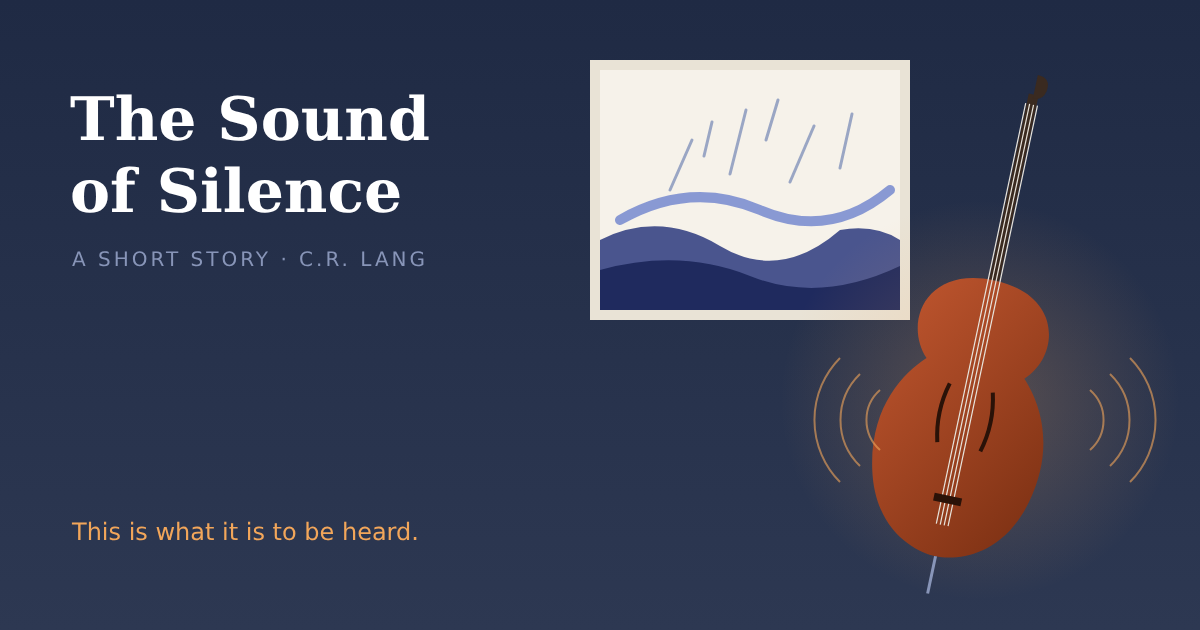
So she did. He played, and she watched his hands and his shoulders and the line of his throat, and she translated the way the music moved through him into color. Low notes became deep, bruised blues that pooled at the bottom of the canvas. High notes became thin, bright strokes of silver that skittered upward like sparks. When he slowed, the paint slowed. When he built toward a crescendo, her brush grew wild, and by the end of an hour the canvas was alive with something that was not quite sound and not quite sight.
In return, he asked her to show him her work and to play it back.
She did not understand until he set the cello across his knees and laid her finished painting on the floor in front of him. He studied it for a long time, tracing the heavy blues with one finger. Then he began to play, and what he played was her painting, not the music that had inspired it, but the music he found inside it. It was strange and tender, and it did not match what he had played before, because it was no longer his. It was hers, passed through him.
Maren stood in the gallery with tears running down her face, and she thought: This is what it is to be heard.
They decided to build a show.
They called it Resonance, and they worked on it all through February, side by side in the long white room. Each piece began with one of them and was finished by the other. She painted his cello pieces, and he composed from her canvases, writing the scores in a notation of his own invention, a language of pressure and weight and vibration that no hearing musician would have recognized.
The gallery’s owner, a brisk woman named Pell, came in one evening to check on their progress and stopped in the doorway with her mouth slightly open.
“It’s a silent exhibition,” she said at last. “Isn’t it? There’s nothing here for the ear.”
“There’s everything for the ear,” Maren said, and it was the first time she had said anything aloud in that room for weeks. Elias, who could not hear her, looked up at the sound of her voice anyway, reading the shape of it in her face. “It just has to come in another way.”
It was in the last week before the opening that she understood she was in love with him.
She had not expected it. She had thought, if she thought of it at all, that they were collaborators, friends, two people who had found an odd, wonderful bridge between their worlds. But one night, working late, she looked up from her easel and saw him asleep on the gallery floor with the cello beside him, one hand still resting on its neck as though he were afraid it might leave.
She put down her brush. She sat beside him on the cold boards and watched him breathe, and something in her chest opened like a window.
He woke to find her there. He did not speak, and neither did she. She picked up the notebook, and for a long moment she did not write anything at all. Then she took his hand, as he had taken hers on that first afternoon, and turned it over, and pressed it flat against her sternum, over the place where her heart was running.
He went very still. His fingers spread against her ribs, feeling it.
That, she wrote, with her free hand, in letters that shook. That is what I hear when I look at you.
He read it. He read it again. Then, slowly, he laid the notebook aside and drew her toward him, and kissed her with such careful, certain tenderness that she understood he had known for weeks, and had simply been waiting for her to hear it.
The opening was a Friday in March. The gallery was crowded, and at first the visitors did not know what to do. There were no speakers, no soundtrack, no soft ambient music to fill the hush. Only paintings, and beside each one a small platform where the viewer was invited to stand barefoot and place a hand against a wooden panel.
Elias had wired the panels himself. Each one carried the vibrations of a cello piece, played live in the next room, through the floor and the walls and the open palms of strangers.
A woman in a gray coat stood in front of the largest canvas, a great sweep of blue and silver, and laid her hand on the panel. Maren watched her face change. She watched the woman’s shoulders drop, and her eyes close, and her lips part in a small, startled breath.
Beside her, Elias took her hand and signed something she was only beginning to learn. She did not need a translation.
Outside, the city went on making its noise. Inside, in the long white room, the silence was full to the brim, and two people stood in it together, listening.