Echo of the Ancients
Science fiction · Published
The artifact was found at the bottom of a dry lake bed in the Atacama, four hundred meters below the salt crust, by a ground-penetrating radar that had been looking for something else entirely.
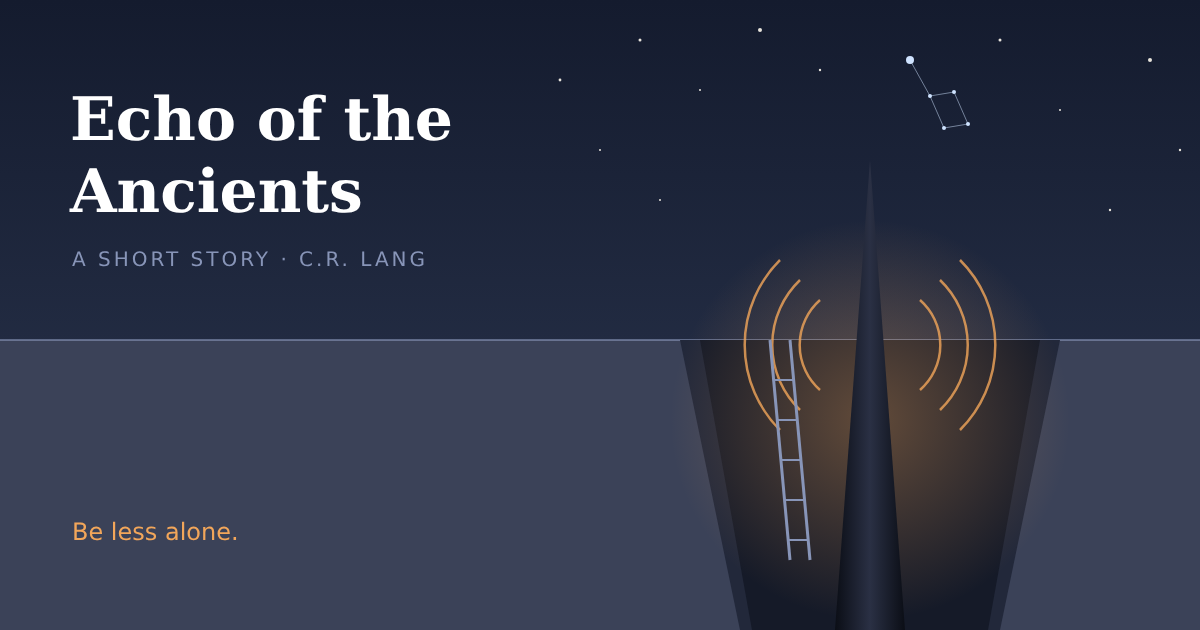
Dr. Ines Marlowe stood at the lip of the excavation on the ninth day, wrapped in a thermal coat against the desert night, and looked down at it under the work lights. It was a spire, perhaps six meters tall, made of a dark, seamless material that no one on the team had been able to scratch. It had no markings, no seams, no hinges. It had been buried, by the geology, for at least eleven million years.
“It’s humming again,” said Tobias Renn, the acoustician, from somewhere behind her.
“It’s always humming.”
“No. This is different.”
She listened. For nine days the spire had produced a low, formless drone that the instruments classified as resonance, the kind of sound a large object makes when wind moves across it. But tonight, beneath the drone, there was a pattern. A stuttering, rhythmic structure, rising and falling.
Tobias had already put on his headphones. His face, in the glare of the work lights, had gone slack.
“Ines,” he said. “It’s saying something. I think it’s saying my name.”
It was not his name, exactly. That was what took them three weeks to understand.
The spire did not speak any language. What it did was listen, and then answer. Its surface was a lattice of microscopic resonators, tuned to sample the sounds around it and recombine them into something close to speech. It had absorbed the team’s voices through the first nine days, and was now playing fragments back, scrambled and imperfect. A Spanish syllable from a driver. A word of Tobias’s Danish. The clatter of a dropped tool, shaped into a rhythm.
It was learning them. And as it learned, the fragments grew more coherent, until one night in early March, standing in the cold with the whole team gathered in a circle around the pit, they heard the spire say, in Ines’s own voice, slow and strangely gentle:
Listen. We do not have much time. Listen.
Nobody moved. The wind scraped across the salt.
“It’s an interface,” whispered Tobias. “It’s not a message. It’s a teacher. It’s built to teach whoever finds it how to hear it.”
“Then let’s learn,” said Ines.
They worked through the spring. Linguists were flown in from Geneva and Kyoto, and the site grew into a small, sleepless town of tents and generators. The spire taught patiently. It built its language from the ground up, pairing sounds to images projected on its surface, numbers to sequences of tones, and eventually, abstractions, grief and distance and later, concepts no human tongue had ever needed to separate.
By May, they could follow it. And what it had to say was a warning.
It had been built by a species the spire called only the Keepers, who had lived in the Orion arm long before any living thing walked upright on Earth. They had watched their own star system die. A cascade, slow and silent, rippling out from a point in space they could not locate, had stripped their worlds of everything that could sustain them. They had spent their final centuries building spires like this one and scattering them across the galaxy, each tuned to a young world, each waiting for a species to grow ears.
We could not stop it, the spire said, in Tobias’s voice, in Ines’s voice, in a chorus of the whole team’s voices blended into one. But we learned its pattern. It returns. It moves outward from the core, along a path we calculated. It will reach your system. We cannot say when. Only that you must listen for the signal.
“What signal?” Ines asked it aloud. It was past three in the morning, and she was the only one still at the site.
The spire hummed. And then it sang her a sequence of eleven tones, falling and rising, so quiet that she thought for a moment she had imagined it.
When you hear this, it is already begun.
She sat with the tones in her notebook for a week before she thought to check them against anything. Tobias ran the sequence through a database of known astronomical signals, expecting nothing.
He found it in four minutes.
It was in the archive of a radio observatory in West Virginia, a faint, repeating burst recorded eleven years earlier and filed as instrument noise. Eleven tones, falling and rising. The same shape. The same interval. Pulsing from a point in the constellation Lyra, and growing, imperceptibly, stronger each year.
“It’s already begun,” said Tobias hoarsely.
“How long?”
He worked the numbers. He worked them again, and again, with a pencil, because he did not trust the machine. When he looked up, his eyes were wet.
“Forty years. Perhaps fifty. If the Keepers’ model is right.”
The silence in the trailer was complete. Somewhere outside, the spire was humming to itself in the dark, a low and patient sound, like a lullaby sung by someone who knew how it ended.
They did not keep it secret. Ines argued for that, loudly, against the advice of the ministers who flew in from Santiago and Washington. She argued that you could not hide a thing that the entire sky was going to announce, and that fear shared was easier to bear than fear withheld. In the end, the data was published, the Lyra signal verified by a dozen independent observatories, and the world, for a long and terrible winter, held its breath.
Then the spire spoke again, and this time it said something new.
You are not the first to hear us, it said. There is another. Far from here. They too received a spire. They too have been listening. We have felt their answers, faintly, across the dark. You are not alone in this. Reach toward them.
It showed them a direction. A star, nineteen light years away, so ordinary that no one had ever looked at it twice. And in the weeks that followed, as the telescopes of the world swung toward it, they found the faintest of replies. A pattern of light, flickering at the edge of detection. Eleven tones, in a different shape, a different hand.
Someone out there was building the same answer.
On the last night of the expedition, Ines climbed down the ladder into the pit alone and laid her palm against the spire’s cold, dark surface. It was warm. It thrummed against her skin like a living throat.
“Will it be enough?” she asked. “Two worlds. Against whatever that is.”
The spire was quiet for a long time. Then it spoke, in a voice that was not hers, or Tobias’s, or anyone’s. It was a voice assembled from all of them and from none, ancient and tender and tired.
The Keepers were alone, it said. That is why they are gone. Be less alone.
She stood in the dark for a long while, with her hand against the humming metal. Far above, through the mouth of the pit, the stars were coming out over the Atacama, and one of them, a small, ordinary star in the constellation Lyra, was sending its patient, deadly message down toward Earth.
Ines Marlowe took her notebook out of her coat, turned to a clean page, and began, in the slow, careful hand of someone writing a letter to a stranger, to compose their reply.