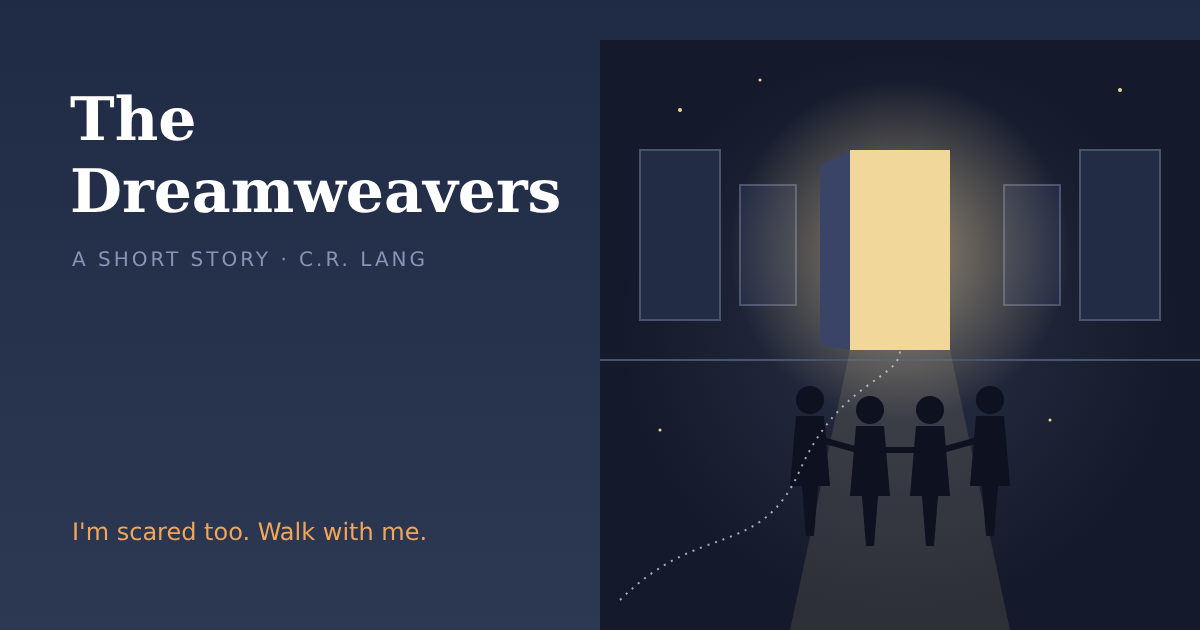
The Dreamweavers
Science fiction · Published
In the city of Somnia, sleep was a trade.
People no longer simply dreamed. They commissioned. In the soft-lit parlors along Lethe Street, clients lay on low couches while weavers worked at their bedsides, threading raw sleep into finished experiences: a flight over Himalayan snow, a last conversation with a dead parent, a summer that never ended. The best weavers were famous. The worst were quietly sued.
Calla Rennick was neither. She was merely the one people came to when they were afraid.
Her specialty was the confrontation dream. A man terrified of drowning would come to her and lie down, and Calla would build him an ocean, then teach him, gently, to breathe in it. A woman haunted by her father’s temper would find herself in a kitchen with a smaller, quieter version of him, and learn to say the words she had swallowed for thirty years. Calla never forced anyone. She constructed the door, and the dreamer chose whether to open it.
She had done it four hundred times without incident, and she had a rule that kept her safe: a weaver never dreams her own dreams. She wove from the outside, tethered to the waking world by a silver thread of attention, like a diver on a line. The rule was old and absolute. Every weaver learned it in her first week.
Calla broke it on a Thursday, out of tiredness.
Three clients were scheduled that evening, in a shared dream she had designed for a small group with a common fear, the dark. It was a delicate piece, a vast house with lightless rooms, each one offering a gentler shadow than the last. She had built it over a week. She tested the final threads at midnight, alone in the parlor, and her attention slipped. For a single instant, she let herself fall asleep inside her own weave.
The silver thread snapped.
She woke inside the house. It was her house, her design, but something was wrong with it. The walls breathed. The corridors ran longer than she had drawn them. And from somewhere deep in the dark came the sound of three people calling her name.
Calla. Calla, we can’t find the door.
She understood at once what she had done. The dream was meant to be gentle, but dreams absorb the mind that enters them, and hers had been full of something she had never admitted to herself. The house had begun to fill with her own fears.
It was not the dark she was afraid of. That would have been simple.
She found it out by walking. In the first room, the shadows had her mother’s shape, bent and gray, saying you were never enough. In the second, a long table was laid with unfinished dreams, hundreds of them, each one a client she had failed to help, their faces blank and waiting. In the third, a mirror hung on the wall, and in it she saw herself as she really feared she was: a woman who had spent her life teaching others to be brave and had never once been brave herself.
“I only build the door,” she whispered. “I never walk through.”
The mirror smiled with her mouth. Then you are the only one in this house who is truly lost.
The calls from the dark grew fainter. Her clients were slipping deeper, and the house was folding around them, because she, its architect, had stopped believing she could lead anyone out.
She nearly gave up in the fourth room. It was a bare white chamber with a single chair, and she sat in it, and the dread rose around her like water. She thought about how easy it would be to let the dream close. She thought about the faces at the table.
Then she remembered what she told every client, in every parlor, before the first thread was laid.
You don’t have to defeat it. You only have to look at it, and keep walking.
She had said it four hundred times. She had never needed it.
Calla stood. She turned back to the mirror, and the gray mother, and the table of blank faces, and for the first time in her career she did not try to rebuild or fix them. She looked. She let the fear be as large as it was. And she said aloud, in a voice that shook, “Yes. I’m afraid I’m not enough. I’m afraid I’ve been hiding behind other people’s courage. I’m here anyway.”
The mirror cracked down the middle. The gray mother loosened and dissolved like smoke, and the faces at the table drew breath and began to murmur, and the walls of the house, relieved at last of the weight she had hung on them, exhaled.
She found her clients in the deepest cellar, huddled together beside a door that was not locked. They had been too frightened to try the handle. She took the first by the hand, and the second, and the third, and said the only true thing she had left.
“I’m scared too. Walk with me.”
They crossed the threshold together, and the house gave way to morning light.
She woke in the parlor with her cheek pressed against the cool tile and the silver thread, repaired, humming gently at her wrist. Her three clients stirred on their couches, blinking, tearful, and unharmed. One of them, an older man who had come to conquer a lifelong terror of darkness, reached for her hand and said, with wonder, “I was so afraid, and then I wasn’t. It was like someone was afraid with me.”
Calla held his hand and did not trust herself to answer.
She broke the rule again, afterward, but on purpose. Once a month, she lay down on her own couch and let another weaver build her a dream, and she walked through its doors beside her clients, and was afraid with them. The old guild scolded her. The younger weavers began to follow her example.
In time, Lethe Street grew a little less quiet. Weavers sat at the bedsides of their clients and no longer stood outside the dream. They went in together, and when the dark rose around them, as it always does, they held the same line, and walked.