The Memory Market
Science fiction · Published
Tamsin Okoro first noticed the gap on a Tuesday, when she could not remember her sister’s wedding.
She remembered being invited. She remembered the dress she had bought, a deep green thing she had hemmed herself, and the argument with the airline about her luggage. But the day itself was a smooth white space, as though someone had taken a razor to the film. She sat at her kitchen table with a cold cup of tea and tried to enter it from every side. Nothing. Her sister’s face at the altar would not come.
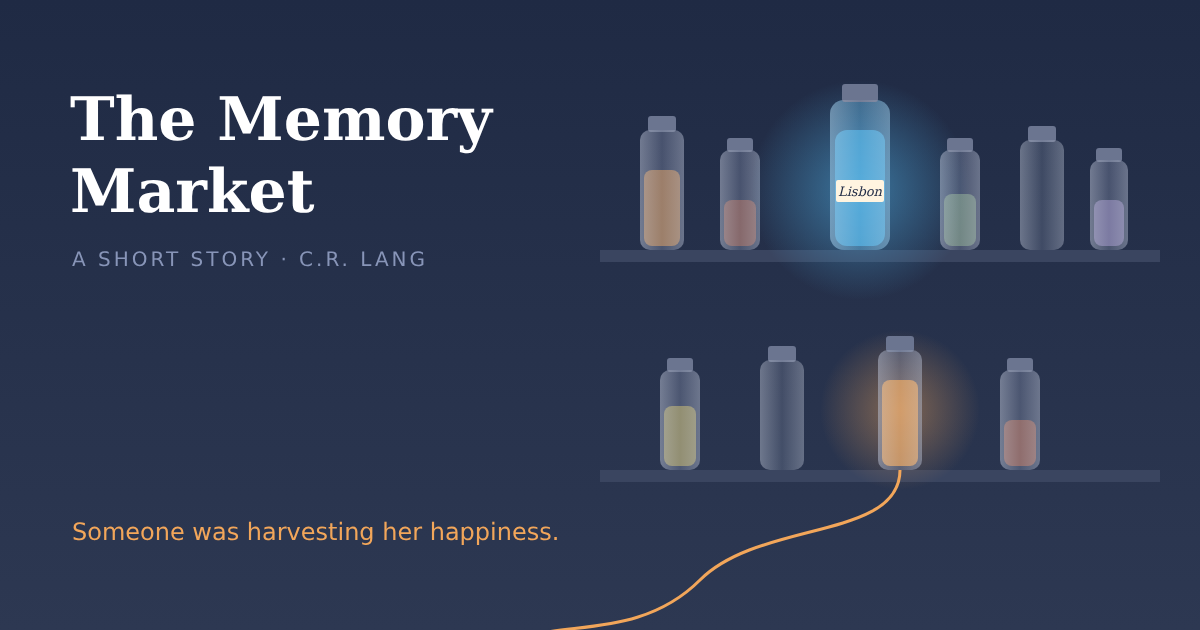
In 2061, a missing memory was not unusual. People sold them every day. The Exchange on Marrow Street traded in everything from childhood summers to first kisses, pulled out in clean, painless sessions and bottled in glass. Tamsin had sold a few herself, years ago, minor grief mostly, a bad breakup, a funeral she was glad to be rid of. She had signed the forms. She knew exactly what she had given away.
She had not sold her sister’s wedding.
She went to the Exchange the next morning and asked to see her own ledger. The clerk, a young man with a polite, practiced smile, informed her that transaction records were confidential to the seller.
“I am the seller,” said Tamsin.
He checked. His smile tightened a fraction. “Ms. Okoro, our records show a sale under your authorization last month. A single block. It was auctioned the same week.”
“I never authorized anything.”
“The consent verification was biometric.” He turned his screen toward her. There was her signature, her retinal scan, her voiceprint, all perfect. “Everything matches.”
She went home and made a list. Then she went through her flat, and through her own head, and began to count what else was gone. It took three days. The wedding. A week in Lisbon. The first apartment she ever rented. Her mother’s voice on the phone, in the last year of her life. They were not random. They were the warmest things she owned.
Someone was harvesting her happiness, and they were doing it with her own face.
She was an engineer by training, which meant she trusted traces. The Exchange could stonewall her, but the auction houses kept public bid histories, anonymized and slow to update. She spent two weeks in the archive of a gray-market broker called Sable & Vane, reading buyers’ pseudonyms like tea leaves. The wedding had sold for a startling sum to a bidder known only as Lantern. Lisbon had gone to Lantern too. So had the apartment, and the phone calls.
Whoever Lantern was, they were not collecting a random sample. They wanted a particular life, and they wanted it in order.
She followed the money through shell accounts until it surfaced, absurdly, at a private clinic on the edge of the city, a low white building behind a screen of cypress called the Alder Institute. Its brochure promised restorative cognitive care for the memory-impaired. She posed as a patient’s daughter and was shown, with some pride, the Institute’s flagship ward.
It was a long, sunlit room. In it, thirty beds. In each bed, a person.
They were not sleeping. They sat propped against pillows, eyes open, serenely smiling at nothing. A nurse was adjusting a drip beside a woman of about sixty, and as Tamsin passed, the woman turned her head and said, in a clear, bright voice, “Oh, you should have seen the water in Lisbon. It was the loveliest blue.”
Tamsin stopped breathing.
The woman had never been to Lisbon. But she described the blue, and the little café with the broken awning, and the old man who had sold Tamsin a paper bag of warm almonds, in the exact words Tamsin had used in a letter to her mother twelve years ago. Then she smiled, the contented, distant smile of someone remembering a good life.
It was Tamsin’s good life. The woman was wearing it.
She broke into the Institute’s records that night. It took four hours and a borrowed access badge. In the director’s office she found the whole machine laid bare, and it was worse than theft.
The Institute had been founded on a theory. Identity, its founders had argued, was nothing more than a sufficient quantity of memory, and could be reassembled from parts. They were running an experiment. Patients who had lost their own histories to dementia, to trauma, to age, were being offered new ones, stitched together from the highest-rated donors. The best lives, the most beloved moments, the richest and warmest days, harvested from thousands of unwitting sellers and transplanted into the empty.
It was marketed as a kindness. It was, in truth, a laboratory for something larger. In the final pages of the director’s private file, headed Phase Four, Tamsin found the real ambition. The Institute did not want to patch broken people. It wanted to prove that a person could be built from the outside, a complete self assembled from purchased pieces, with no original at all.
And Tamsin, whose life had rated unusually high on every metric, was their template.
They had not wanted a few of her memories. They wanted all of them. They had been taking them in pieces, quietly, a little each month, so she would not notice the shape of the loss, until there was nothing left of her but a body and a name. The woman in the sunlit ward was only the prototype. When the harvest was done, there would be a version of Tamsin Okoro in a bed somewhere, smiling, certain of her own history, and perfectly content.
And the original would be a stranger to herself, wandering the streets without even the knowledge of what had been taken.
She did not go to the authorities. They were clients of the Exchange, as everyone was. She did something cleverer and more dangerous. She went back to the ward at dawn with a stolen console and a very simple instruction.
The Institute’s whole premise was that memory could be transferred. But a transfer runs in both directions.
She sat beside the woman who wore her life, took her hand, and connected the two of them through the bedside interface. The woman, still smiling, did not resist. Tamsin closed her eyes, and she pulled.
It was not painless. She felt the Lisbon blue come rushing back, and the wedding, a bright, shouting, glorious confusion of her sister’s laugh and a spilled glass and her mother’s hand on her cheek. She felt her own life pour home like water into a dry riverbed. And as it left, the woman in the bed began to dim, her smile wavering, her eyes searching the room with the wide, frightened look of a person waking from someone else’s dream.
“I’m sorry,” Tamsin whispered. “I’m so sorry. You’ll get something of your own. I promise. I’ll make them give it back.”
She did not know if it was true. She did not know whether any of the thirty in that ward had anything of their own left to return to. But she knew now what the Institute had never understood, what no auction could price. A memory was not an object. It was a thread, and the self was only what you wove from it, and no one could weave for you.
She uploaded the director’s files to every news feed in the city, and then she walked out of the Alder Institute into a bright, cold morning. She still had a great many gaps. She would be filling them for the rest of her life, with sisters and phone calls and new, unpolished days.
But they were hers. And as the first sirens came wailing up the road, Tamsin Okoro put her hands in her pockets and began, slowly and on purpose, to remember her way home.